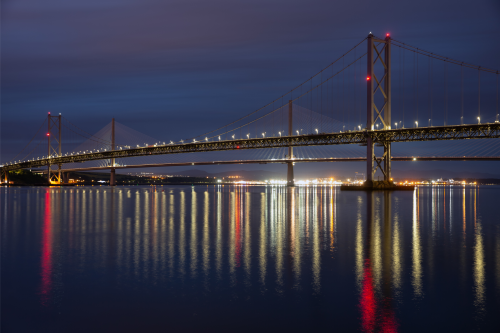
Closing one of Scotland’s most recognisable bridges for a mass-participation running event is anything but routine.
Supernova Forth Road Bridge gives participants the rare opportunity to run, jog or walk across the traffic-free carriageway after dark. The 5K begins in South Queensferry, passes beneath the bridge and climbs onto its main deck before turning towards North Queensferry and returning to the finish.
Headtorches, fluorescent clothing and illuminated accessories create a moving ribbon of light across the Forth. For participants, it is a spectacular evening. Behind the scenes, it is a tightly controlled infrastructure operation involving bridge authorities, traffic managers, emergency services, medical professionals, transport providers, volunteers and event staff.
The public may experience the event for an hour or two. The operation begins long before the first runner arrives and continues well after the finish line closes.
Securing an Iconic Bridge
The Forth Road Bridge cannot become a race route until normal traffic has been diverted safely. Closing the bridge involves much more than placing barriers at either end. Traffic-management teams install advance warning signs and diversions across the surrounding road network. Vehicles are directed towards the Queensferry Crossing, while access points to the event carriageway are secured. The closure timeline begins many hours before the start. This gives contractors enough time to install timing equipment, barriers, lighting, signage and emergency infrastructure.
Bridge access remains available to authorised vehicles and emergency responders under controlled conditions. Every team needs to understand who can enter, which route they should use and who has authority to approve movement. A single unauthorised vehicle on the course would present a serious risk. Critical access points are therefore staffed or secured throughout the event. The bridge cannot reopen immediately after the final participant finishes. Every piece of temporary equipment must be removed, the carriageway inspected and normal traffic arrangements restored in an approved sequence.
Designing an Out-and-Back Route
The Supernova route begins in South Queensferry, travels beneath the bridge and uses access roads to reach the main carriageway. Participants head towards North Queensferry before turning and returning to the finish in South Queensferry. An out-and-back design requires careful separation between people travelling in opposite directions. Barriers, cones and signs need to create distinct lanes without reducing the available width too far. The turnaround area must be large enough for runners to change direction safely. A tight turn could cause congestion, particularly when groups of walkers and faster participants arrive together. Course designers also preserve an emergency-access lane. Medical vehicles and event staff need a route that remains available even during the busiest part of the event. The gradient of the bridge affects participant speed. Runners may slow on the climb and accelerate on the return, changing the spacing between groups. Wind exposure also influences movement. A strong crosswind or headwind can cause participants to change position unexpectedly, so the course must provide adequate width. The measured route accounts for the exact start, turnaround and finish positions. Timing equipment and distance signs are then installed according to that measurement.
Working in an Exposed Environment
Weather is one of the event’s most significant variables. Conditions on the Forth Road Bridge can be very different from those in sheltered streets nearby. Wind speed, direction, temperature and visibility may change quickly. The operations team monitors forecasts throughout the week and receives updated information as the event approaches. Infrastructure that is stable in a park may behave differently on an exposed bridge. Signs, barriers and lighting equipment require suitable fixings or ballast. Anything that becomes loose could create a hazard for participants or fall from the bridge. Installation teams therefore follow methods appropriate to the structure and expected conditions. Staff positioned on the bridge need protection from wind chill and rain. Participants remain warm by moving, but volunteers may stand in one place for several hours. Supervisors consider clothing guidance, shift lengths and opportunities for relief. Shelter may be limited, making preparation especially important. Safety thresholds are agreed before the event. If wind, visibility or another condition exceeds acceptable limits, organisers may need to delay, modify or cancel activity. Those decisions involve operational leaders and relevant bridge authorities. The atmosphere and investment surrounding the event never override safety.
Lighting the Route
Personal headtorches and fluorescent accessories create the Supernova atmosphere, but operational lighting has a separate purpose. Critical points such as the start, ramps, bridge entry, turnaround and finish must remain clearly visible. Temporary lighting may also support medical positions, baggage facilities and pedestrian routes. Reflective signs guide participants without creating excessive glare. Lighting should reveal a turn or hazard rather than shine directly into runners’ eyes. Power systems are installed and tested before darkness. Connections need protection from rain, wind and public contact. Critical systems may have backup power. A decorative feature can remain dark if it fails, but the timing system or a safety light at a major turn requires a contingency. Technical teams remain available during the event. If a lighting unit moves or loses power, race control assesses the risk and coordinates a response. Event vehicles and medical responders also use identifying lights. Those signals need to be recognisable without confusing participants about the direction of the course.
Volunteer Deployment on the Bridge
Volunteer positions are planned carefully because reaching or replacing someone on the bridge can take time. Each marshal receives a numbered location or clear structural reference. Describing an incident as “somewhere near the middle” would not be adequate on a bridge more than a mile long. Briefings explain course direction, emergency procedures, radio use and the expected position of participants. Turnaround marshals ensure everyone changes direction at the correct point. They also prevent participants from continuing towards restricted areas. Other volunteers manage the start, finish, baggage facilities and transport queues in South Queensferry. On the bridge, marshals watch for people who are struggling, walking in unexpected areas or attempting to cross the separating line. They also report moved barriers, failed lighting or debris on the carriageway. Volunteer welfare forms part of the operational plan. Supervisors monitor conditions and arrange relief where possible. When the final participant passes, each marshal waits for confirmation before leaving. The course may still contain sweep staff, medical vehicles or clearance crews.
Medical Response on Critical Infrastructure
Medical planning must answer a difficult question: how can assistance reach a participant quickly on a closed and crowded bridge? The operations team identifies access points from both sides of the Forth. Protected lanes allow authorised vehicles to move without entering the main participant flow. Medical teams are positioned so they can approach incidents from the most efficient direction. Marshals use precise bridge-sector references when requesting help. Accurate locations save time and prevent responders travelling from the wrong side. The medical team prepares for falls, breathing difficulties, cardiac incidents, panic reactions and cold exposure. Strong wind can worsen symptoms and complicate treatment. A participant who stops moving may become cold very quickly. Mobile responders carry appropriate lighting and equipment. Race control tracks their location and availability. If one team becomes committed to an incident, control knows which resources remain free elsewhere. The finish area contains further medical support. Participants may feel unwell only after leaving the exposed carriageway and stopping suddenly. Evacuation routes and receiving medical facilities are considered in advance with emergency-service partners.
Race Control and Bridge Command
Race control connects the running event with the wider bridge and traffic operation. It receives information from course sectors, medical teams, transport coordinators, lighting technicians and traffic managers. The team tracks each start wave, the leading participants and the final walker. Sector reports confirm how the field is moving across the bridge. Control also monitors wind readings, visibility, technical systems and the availability of medical resources. Any significant change is shared with the relevant decision-makers. Because the Forth Road Bridge is critical infrastructure, responsibilities and authority need to be clearly defined before event day. If an incident blocks part of the course, race control decides whether participant flow can continue safely or requires temporary adjustment. Radio messages must remain concise and specific. Unnecessary traffic can prevent an urgent message from being heard. Significant decisions are logged with times and actions. This record supports the post-event review and any formal reporting required by partners.
Transporting Thousands of People
South Queensferry cannot absorb unlimited event traffic. Off-site parking and organised transport reduce pressure on local roads. A travel hub such as Gyle Shopping Centre can connect participants with trains, trams, buses and event shuttles. Transport planners estimate how many people will travel in each direction and at what time. Buses need routes that remain open despite bridge and local road closures. Drivers receive specific event instructions and designated loading points. At the travel hub, staff manage ticket checks and departure queues. Passengers need clear information about when the final practical service leaves. Return demand is more difficult to predict. Some participants leave immediately after finishing, while others wait for friends or remain to enjoy the atmosphere. Transport coordinators monitor queues and communicate with vehicle operators. Contingency capacity may be required if a bus is delayed or demand exceeds expectations. Race control and information teams receive updates so they can communicate any disruption.
Protecting South Queensferry
The event affects residents and businesses in South Queensferry as well as bridge users. Road closures and parking suspensions require advance communication. Local people need to understand when restrictions begin, how long they may last and which access arrangements apply. Event teams establish contact channels for questions. On the day, traffic marshals protect closures while responding respectfully to residents. Access passes or approved local routes do not mean general event traffic can use the same roads. Unauthorised parking can block narrow streets, bus routes and emergency access. Enforcement and stewarding therefore form part of the plan. The start and finish infrastructure is positioned to limit disruption while providing sufficient space for participants. After the event, cleaning teams remove waste, signs and temporary materials from streets and paths. Maintaining positive local relationships is essential. The event can return only with the cooperation of the communities surrounding it.
Managing the Public Footpath and Cycleway
The bridge’s public footpath and cycleway may remain available while the event uses the main carriageway. This creates another operational boundary. Cyclists and pedestrians must remain separate from participants and event vehicles. Temporary infrastructure may narrow the path or require cyclists to dismount. Signs communicate these changes before users reach the affected section. Marshals may be positioned where paths meet event access points. They explain restrictions and prevent accidental entry onto the race route. Spectators cannot assume the footpath provides unrestricted access to every part of the event. Emergency and technical teams may also need to cross or use parts of the path. Their movement is coordinated to minimise conflict. The path is inspected after the event to ensure no equipment or waste remains.
Creating the Start-Line Experience
The start in South Queensferry combines excitement with strict operational control. Participants arrive in fluorescent clothing and illuminated accessories, creating a visually energetic crowd. Public-address systems provide instructions over music and general noise. Start staff direct participants into waves based on expected speed or event arrangements. A controlled release prevents too many people reaching the bridge access ramp simultaneously. It also reduces congestion at the turnaround. Timing technicians test the start mats and confirm communication with the results system. Baggage facilities need clear deadlines so vehicles can be secured and ready for participants returning to the same area. Late arrivals present a particular issue. Once the final wave and sweep operation depart, the course cannot remain open indefinitely for individuals. Volunteers need a clear policy and must communicate it consistently.
The Finish and Reunion Operation
The finish in South Queensferry provides the final burst of light and atmosphere. Timing mats and finish cameras record participants as they return. Technical systems need dependable power and protection from the weather. Runners and walkers require room to slow down after crossing. Volunteers prevent people from stopping immediately beyond the line. Medals, hydration and other finishers’ items are distributed in sequence. Medical staff monitor people leaving the bridge, watching for signs of cold exposure, dizziness or unusual distress. Baggage collection is positioned to allow participants to retrieve warm clothing quickly. Transport information also needs to be visible. People leaving the finish should understand where to find buses and whether queues have developed.
Reopening the Bridge
The event is not finished when the final participant crosses the line. Sweep teams confirm that no runner remains on the route. Course crews then begin removing the turnaround, barriers, cones, signs, lighting and timing equipment. Every item must be accounted for. Loose material cannot remain on a bridge that will soon carry normal traffic again. Electrical systems are isolated and dismantled safely. Waste teams inspect the carriageway and bridge approaches. Bridge authorities assess the route and confirm that it is ready to reopen. Traffic-management teams remove diversions in an approved order. Releasing one barrier too early could send vehicles towards a section where crews are still working. Normal operation resumes only after the full system is safe.
Learning From a Unique Event
A post-event review examines every stage of the operation. Organisers consider weather monitoring, bridge setup, start waves, volunteer welfare, medical activity and transport performance. Reports from bridge authorities and traffic teams are reviewed alongside participant feedback. Volunteer observations can identify dark sections, confusing signs or welfare concerns that were not visible from race control. Transport data shows whether off-site parking and shuttle capacity matched demand. Every incident and significant decision is discussed. The objective is to strengthen the plan rather than assign blame.
The People Behind the Crossing
Supernova Forth Road Bridge feels like a once-in-a-lifetime adventure because participants briefly occupy a space normally associated with transport rather than sport. Creating that experience requires discipline and cooperation. Traffic teams divert vehicles safely. Technical crews secure equipment against the wind. Medics prepare to reach incidents on an exposed structure. Volunteers stand at assigned positions in the dark, and transport staff move thousands of people without overwhelming South Queensferry. The runners provide the moving lights, but a much larger team makes their journey possible. Behind every photograph of the illuminated bridge is an operation that began before the road closed and continued until the final barrier was removed.