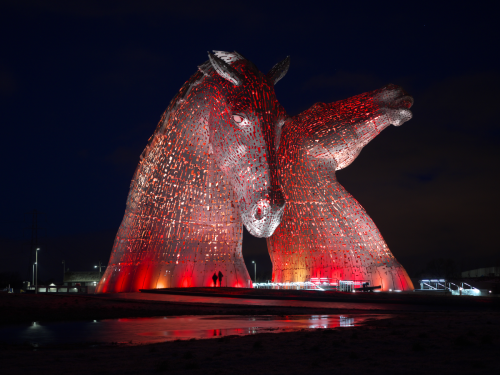
At dusk, Helix Park begins to change. The Kelpies glow in shifting colours, runners gather in fluorescent clothing and hundreds of headtorches create a moving trail of light through the landscape. For participants, Supernova Kelpies is a fun and inclusive 5K in one of Scotland’s most distinctive settings. Families, first-time runners, walkers and experienced athletes all share the course, with the illuminated sculptures providing an unforgettable background. Behind that magical public experience is a serious event operation. Delivering a mass-participation race after dark requires detailed planning around lighting, visibility, weather, public access, medical response, parking and participant movement. The event may last for only part of an evening, but the work begins months in advance and continues after the final light has disappeared from the course.
Designing an Event Around Light
Lighting is both part of the Supernova experience and an essential part of its safety plan. The route team inspects the entire 5K course and identifies where existing park lighting is sufficient. Darker sections, turns, surface changes and narrow paths may require reflective signs, temporary illumination or additional marshals. Participants receive or wear headtorches, but organisers cannot rely on every individual light working perfectly. Batteries fail, lights can be dropped and some participants may not position them correctly. The course must therefore remain understandable even when someone’s personal light is unavailable. Operational lighting serves a different purpose from decorative lighting. Coloured installations and illuminated branding create atmosphere, while practical lighting makes toilets, baggage facilities, emergency routes and the finish area safe. The two systems must work together. A dramatic light display cannot be allowed to obscure a directional sign or dazzle participants approaching a turn. Every electrical installation requires suitable power, weather protection and backup arrangements.
Transforming Helix Park
Helix Park is a public space rather than a permanent running venue. Before the event, contractors and staff bring in barriers, toilets, timing equipment, baggage facilities, event signage, lighting and communications infrastructure. Each installation must be positioned carefully. Public paths need to remain accessible where required, while emergency routes cannot be blocked by temporary structures. The start and finish areas require enough room for large groups without damaging the surrounding landscape. Vehicle access is controlled. Deliveries must arrive according to schedule because the park’s normal car parks may close before participants begin arriving. The course team walks the route to identify hazards such as standing water, mud, fallen branches, loose gravel or damaged surfaces. A second inspection may take place as daylight fades. A feature that is obvious during the afternoon can become difficult to see after dark. Any problem must be cleaned, marked, illuminated or removed before the first wave begins.
Planning for a Family Audience
Supernova Kelpies welcomes a broader participant group than many competitive road races. Children may take part with an accompanying adult, while walkers, buggies and wheelchair users can create a wide range of speeds across the course. Start waves help manage those differences. Faster runners are positioned ahead of participants who intend to walk or move at a more relaxed pace. Staff and volunteers explain where people should assemble and why the wave system matters. The objective is not to separate participants by perceived ability but to reduce overtaking conflicts on narrower paths. Family participation also adds safeguarding responsibilities. Organisers establish procedures for lost children and separated groups. Staff know where to direct a child who cannot find an adult and how to contact the appropriate supervisor. Meeting and reunion areas are clearly communicated. Parents are encouraged to agree on a location before the event begins. Information needs to be accessible and reassuring. First-time participants may be unfamiliar with race terminology, starting pens or timing chips, so volunteers avoid assuming prior knowledge.
The Start-Line Operation
The Supernova start must feel exciting without becoming chaotic. Participants arrive wearing illuminated costumes, fluorescent accessories and headtorches. Music and lighting build anticipation, but operational announcements still need to be heard. The start team checks that pens are filling at a safe rate. Volunteers direct participants into the correct waves and keep access routes clear. Timing technicians test the mats and make sure the system is ready to register every participant. The field is released in controlled groups. This prevents too many people reaching narrow course sections simultaneously. Late arrivals create a separate challenge. Once the final wave and sweep operation leave, the start cannot remain open indefinitely. Staff need a clear policy for anyone who misses their allocated time. Allowing an individual onto a partially dismantled course could place them beyond marshal or medical coverage. After the final wave departs, the start team reorganises the area for returning finishers.
Volunteers Working After Dark
Volunteers are essential to any running event, but darkness changes the way they work. Every marshal needs high-visibility clothing, appropriate lighting and a clearly defined position. Briefings use numbered locations and recognisable landmarks. Describing an incident as being “near the path” is not useful in a large park at night. Marshals guide participants, monitor public crossings and report hazards. They may also reassure runners who feel uncertain in a darker or quieter section. Visibility works in both directions. Participants need to see volunteers, and race control needs confidence that every position remains staffed. Radio communication becomes especially important because teams cannot rely on visual contact across the park. Volunteers receive instructions about how to use torches without shining them directly into participants’ eyes. Their welfare is part of the event plan. Standing still after dark can feel much colder than running, so clothing guidance, refreshments and breaks matter. Supervisors check positions and ensure that no marshal is forgotten when the course begins to close.
Medical Planning at Night
Medical teams prepare for incidents ranging from minor trips to serious illness. Low light can make it harder to assess injuries and reach someone quickly. Treatment areas therefore need reliable illumination and clear vehicle access. Mobile responders carry suitable lighting and know the fastest entry point for each section of the course. Marshals reporting an incident use specific location numbers and describe what they can see. Race control then assigns the nearest appropriate response. The team prepares for falls, muscle injuries, breathing difficulties, cardiac incidents and cold exposure. Fancy dress can introduce additional concerns. A costume may restrict movement, cause overheating or create a trip hazard. Participants who have been comfortable while moving may become cold quickly after finishing. Volunteers and clinicians monitor people in the recovery area for signs of distress or confusion. Children may react differently to an injury or unfamiliar medical environment. Staff communicate calmly and involve parents or guardians appropriately.
Race Control and Event Communications
Race control connects the course, medical teams, lighting technicians, parking staff and finish operation. The team receives confirmation when each wave starts and tracks the progress of the leading and final participants. If a sign falls, a section becomes slippery or a lighting unit fails, race control coordinates the response. Technical failures are assessed according to safety rather than appearance. A decorative feature can potentially remain off, but a dark critical turn may require immediate replacement lighting. Radios are tested before the event. Call signs and location references are agreed so messages remain concise. Race control also monitors weather, crowd density and the availability of medical resources. Significant decisions are recorded. This creates an accurate timeline for the post-event review and helps organisers understand which contingency plans were used.
Powering the Supernova Experience
A night event relies on electrical systems more heavily than an ordinary daytime race. Timing equipment, event lighting, public-address systems and operational workspaces all need dependable power. Electricians or technical contractors install distribution systems and protect connections from rain and public access. Generators must be positioned so fumes and noise do not affect participants. Cables need covers or routes that prevent trip hazards. Critical systems may have backup power. Timing data should not be lost because one supply fails. Lighting is tested before darkness and checked again once environmental conditions match those of the event. If a fault develops, technical staff need safe access to the equipment without entering the participant flow. The public may see a colourful display, but behind it is a disciplined electrical installation designed for a busy outdoor environment.
Parking and Participant Arrival
Helix Park cannot accommodate unrestricted event traffic. Its normal car parks, including those closest to the Kelpies, may close on event day. Participants and spectators are directed towards approved alternatives such as Falkirk Stadium. Traffic teams install signs and staff key approaches. Their work prevents drivers following their ordinary route into a closed area. Accessible parking bays are identified separately, and pedestrian routes from parking to the event are checked for suitability. Public buses and Falkirk Grahamston station provide other options. However, evening timetables affect how people plan their journeys home. The arrival period creates concentrated demand. Hundreds of vehicles and pedestrians may reach the area within a short time. Volunteers direct people towards the start while keeping pavements, local roads and emergency routes clear. After the race, lighting and signage help everyone return to parking and public transport safely.
Managing Helix Park as a Shared Space
The event takes place in a park that continues to matter to local residents, businesses and other users. Advance communication explains parking restrictions, access arrangements and expected event times. Some paths may remain open, meaning marshals need to manage interactions between runners and members of the public. The course cannot spread across every available space. Emergency access, visitor facilities and local routes must all remain functional. Dogs may be present in public areas, although event rules restrict them from the running route unless they are assistance animals. Marshals respond to questions respectfully while maintaining the boundaries needed for participant safety. The organiser’s responsibility extends beyond delivering the race. The park must be protected, cleaned and returned in good condition.
Creating a Safe and Memorable Finish
The finish area combines accurate timing with theatrical atmosphere. Timing mats and finish cameras require dependable power and protection from weather. Barriers create a clear funnel that keeps spectators away from arriving participants. Lighting makes the final approach visually memorable, but it must not interfere with the timing system or medical observation. Runners need room to slow down after crossing. Volunteers encourage them to continue towards medals, hydration and baggage. Stopping directly beyond the line could cause a collision with participants finishing behind. Families are directed towards a reunion area rather than entering the finish funnel. This keeps operational and emergency routes open. Photographers work from controlled positions so they can capture the Kelpies without stepping into participant flow. Medical staff remain close to the line, watching for anyone who appears unsteady, cold or unwell.
Cleaning and Restoring the Park
When the final participant finishes, the dismantling operation begins. Course crews collect signs, cones, barriers and temporary lighting. Electrical systems are isolated and removed by the appropriate staff. Waste teams inspect the park for bottles, packaging, glow products and cable ties. Darkness makes it difficult to guarantee that every small item has been found, so another inspection may take place in daylight. Baggage teams reconcile unclaimed items, while timing staff secure results and technical equipment. Toilets and larger structures are collected according to a schedule that maintains access for workers. The start, finish and car-parking arrangements are then returned to their normal configuration.
Learning From the Night
A post-event review considers more than finishing times and participant numbers. Organisers examine whether start waves produced safe spacing, whether lighting was effective and whether parking capacity matched demand. Medical reports show where incidents occurred, while volunteer feedback reveals sections that felt too dark, crowded or difficult to manage. Lost-child procedures and family reunion arrangements are reviewed carefully. Comments from local residents and park partners help the team assess the wider impact. Even a successful event produces lessons. A sign may need to be larger, a marshal moved to a different corner or transport information issued earlier.
The People Behind the Glow
Supernova Kelpies succeeds when participants feel that the magic happened naturally. In reality, that experience is supported by electricians protecting power systems, medics preparing for incidents, marshals standing on dark paths and traffic teams guiding vehicles away from closed car parks. Baggage volunteers protect participants’ belongings. Timing technicians record thousands of individual achievements. Course crews return after the finish to make sure the park is clean. The Kelpies provide the spectacular setting, but people deliver the event. Behind every photograph of glowing runners and illuminated sculptures is a team that arrived in daylight, worked through the darkness and remained after the final participant had gone home.